英検2級 熟語・イディオム一覧|大問1で実際に出た約70語+覚えておきたい頻出フレーズ
公開 2026.7.8
英検2級の大問1、後半の熟語問題(11〜17問目)で足を止められたことはありませんか。単語帳の隅に小さく載っているだけで、まとめて覚える機会がないまま本番を迎えてしまう——そういう人は多いです。
この記事は、そのための一覧です。英ピタが英検2級の直近10回ぶんの大問1を1問ずつ分析し、実際に問われた熟語・イディオムを約70語、英ピタの分析にもとづいてまとめました。加えて、まだ出題は確認できていないものの、覚えておく価値が高い頻出フレーズを英ピタが厳選して約40語追加しています。この2つを合わせて、意味と例文つきで一気に見渡せるようにしています。読み終える頃には、大問1の熟語パートで「見たことがない」がぐっと減っているはずです。
英検2級の熟語問題とは──大問1の17問中、約7問(4割)
まず前提を正確にそろえておきます。英検2級の大問1(短文の語句空所補充)は全17問。2024年のリニューアルで、それまで20問あったうち文法問題3問(18〜20問目)が廃止され、現在は17問構成です(この「文法0問」を実施6回・102問を数えて確かめた過程は英検2級の難易度は上がった?にまとめています)。
| 区分 | 問題番号 | 問数 | 内容 |
|---|---|---|---|
| 単語問題 | 1〜10問目 | 10問 | 名詞・動詞・形容詞・副詞(1語) |
| 熟語問題 | 11〜17問目 | 7問(約4割) | 句動詞・定型イディオム・語法表現 |
| 文法問題 | ― | 0問(2024年に廃止) | ― |
大問1の後半、11〜17問目がまるごと熟語問題です。単語問題(10問)より数は少ないものの、17問中の約4割を占めるので、ここを取りこぼすと大問1全体の得点が大きく下がります。逆に言えば、熟語をまとめて押さえておくだけで、大問1の4割が「見たことがある」問題に変わります。
なお、ここでいう「熟語」は句動詞(get off のような動詞+前置詞/副詞)だけでなく、in person のような前置詞+名詞の定型イディオムも含みます。句動詞の解き方・覚え方をじっくり知りたい場合は、姉妹記事「英検2級 大問1は熟語(句動詞)で4割取れる|よく出る句動詞リストと覚え方」も参考にしてください。単語(1語)の覚え方は「英検2級 単語の覚え方」にまとめています。
なぜ熟語は覚えにくいのか
熟語がなかなか定着しない理由は、だいたい同じです。
- 単語帳の中に埋もれている — 熟語だけをまとめて見る機会がほとんどない
- 意味が単語から推測できない — take と pains を知っていても「骨を折る」という意味にはたどり着けない
- 「本当に出るのか」が分からない — 覚えても出ないかもしれない不安から、後回しにされがち
3つ目が一番厄介です。だからこの記事では、まず「英ピタが過去問を分析して、実際に出題を確認した熟語」を先にまとめます。ここから覚えれば、少なくとも「出ないかもしれない」という不安はなくなります。
【最重要】実際に出題された熟語・イディオム一覧(約70語)
英ピタは、英検2級の大問1(2023年度第1回〜2026年度第1回・計10回ぶん)を1問ずつ分析し、そこで問われた熟語・イディオムを記録してきました。ここに挙げるのは、その分析で実際に出題が確認された熟語・イディオムです。過去問の原文はそのまま載せていません(著作権配慮)が、語そのものは実際に出たものです。例文はすべてオリジナルで作成しています。
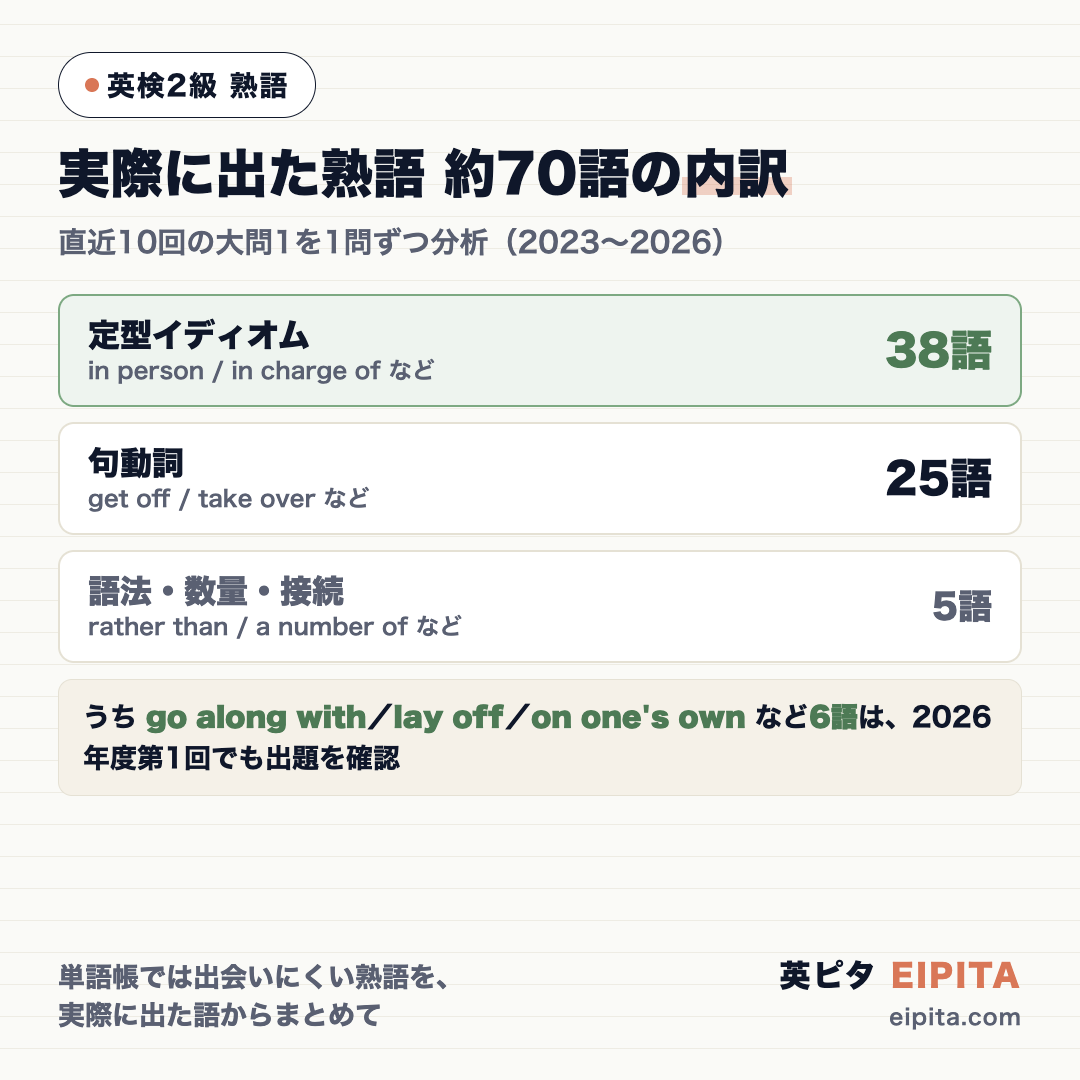
大きく3つに分けて掲載します。10回ぶんをユニークな語で数えると、句動詞が25語・定型イディオムが38語・語法表現が5語という内訳です(1回の熟語問題だけを見ると句動詞と定型イディオムはおおむね半々ですが、10回分をまとめて種類で数えるとイディオムの方が多くなります)。
句動詞(25語・実際に出題)
| 句動詞 | 意味 | 例文 |
|---|---|---|
| set aside | 〜を取っておく | She set aside some money for her trip. |
| shut off | (電気・ガスなどを)止める | The workers shut off the water for repairs. |
| bring out | 〜を売り出す、引き出す | The company will bring out a new phone next month. |
| flow into | 〜に流れ込む | The river flows into the sea near this town. |
| take over | 〜を引き継ぐ | His daughter will take over the shop someday. |
| do without | 〜なしで済ませる | We had to do without electricity for a day. |
| think over | 〜をよく考える | Please think over the plan before you decide. |
| do away with | 〜を廃止する | The city decided to do away with the old rule. |
| keep track of | 〜を把握する | It’s hard to keep track of all my passwords. |
| stare at | 〜をじっと見つめる | The child stared at the fireworks in the sky. |
| drop in | 立ち寄る | Feel free to drop in whenever you’re free. |
| make do with | 〜で間に合わせる | We had to make do with what we had. |
| keep A from B | AにBさせない | The noise kept him from sleeping well. |
| long for | 〜を切望する | People in the city often long for quiet places. |
| get off | (乗り物を)降りる | Don’t forget to get off at the next stop. |
| fall back on | いざという時〜に頼る | She has her savings to fall back on. |
| pick out | 〜を選び出す | He picked out a shirt for the interview. |
| rely on | 〜に頼る | The team relies on her for the final decision. |
| save up | (お金を)貯める | He is saving up for a new bike. |
| feed on | 〜を食べて生きる | These birds feed mainly on insects. |
| go off | (警報などが)鳴る | The alarm went off in the middle of the night. |
| live on | 〜を主食とする | This tribe traditionally lives on fish and rice. |
| participate in | 〜に参加する | Students are encouraged to participate in the event. |
| go along with | 〜に賛成する、従う | I decided to go along with the group’s plan. |
| lay off | 〜を解雇する | The factory had to lay off some workers. |
定型イディオム(38語・実際に出題)
| イディオム | 意味 | 例文 |
|---|---|---|
| disappointed in | 〜に失望して | I was disappointed in the movie’s ending. |
| in person | 直接、本人で | I’d like to thank him in person. |
| in charge of | 〜を担当して | Ms. Lee is in charge of the new project. |
| on and off | 断続的に | It rained on and off all afternoon. |
| typical of | 〜に典型的な | That mistake is typical of a beginner. |
| turn in(出題では turned in の形) | 〜を提出する | Please turn in your essay by Friday. |
| well off | 裕福な | Her family is quite well off. |
| fed up with | 〜にうんざりして | He is fed up with the long commute. |
| gone bad | だめになった、腐った | The milk in the fridge has gone bad. |
| for instance | 例えば | Some fruits, apples for instance, keep well in winter. |
| as a general rule | 原則として | As a general rule, the shop closes at nine. |
| up until now | 今まで | Up until now, no one had noticed the mistake. |
| on good terms | 良好な関係で | The two companies are on good terms. |
| had second thoughts | 考え直した | She had second thoughts about quitting her job. |
| kill time | 時間をつぶす | We killed time by playing cards at the airport. |
| on duty | 勤務中で | Two nurses are on duty tonight. |
| in honor of | 〜に敬意を表して | The park was named in honor of the founder. |
| on the go | 忙しく動き回って | Working parents are always on the go. |
| at the mercy of | 〜のなすがままに | Small boats are at the mercy of the waves. |
| in effect | 実質的に、実施されて | The new law is now in effect. |
| side by side | 並んで | The two teams worked side by side. |
| to my regret | 残念なことに | To my regret, I missed the last train. |
| have a good command of | 〜を使いこなす | She has a good command of three languages. |
| at times | 時々 | Even experts make mistakes at times. |
| for the time being | 当分の間 | The office will stay closed for the time being. |
| identical to | 〜と全く同じ | Her opinion is almost identical to mine. |
| free of charge | 無料で | The museum is free of charge on Sundays. |
| take pains | 骨を折る | She took pains to explain it clearly. |
| more or less | だいたい | The two plans are more or less the same. |
| safe and sound | 無事に | All the hikers returned safe and sound. |
| in search of | 〜を探して | They traveled in search of a better life. |
| take a nap | 昼寝をする | I usually take a nap after lunch. |
| one of these days | そのうち | I’ll visit you one of these days. |
| by and large | 概して | By and large, the plan worked well. |
| on one’s own | 独力で | He finished the project on his own. |
| a series of | 一連の | The company faced a series of problems this year. |
| in other words | 言い換えれば | He’s not answering. In other words, he refuses. |
| distinct from | 〜と異なる | This case is distinct from the others. |
語法・数量・接続の表現(5語・実際に出題)
| 表現 | 意味 | 例文 |
|---|---|---|
| no better than | 〜も同然、〜にすぎない | His English is no better than mine. |
| only a few | ほんのわずかの | Only a few people knew the truth. |
| a number of | いくつかの、多くの | A number of students joined the club. |
| rather than | 〜よりむしろ | I’d walk rather than wait for the bus. |
| as far as | 〜する限りでは | As far as I know, the plan hasn’t changed. |
★ このうち go along with / lay off / on one’s own / a series of / in other words / distinct from の6語は、2026年度第1回という直近の実施回でも出題が確認できています。「昔の過去問にしか出ない語」ではなく、今も現役で狙われる語ということです。
覚えておきたい頻出熟語(英ピタ厳選・約40語)
ここから先は、上の「実際に出題された」リストとは性質が違います。英ピタが約1,650語の学習データの中から、よく使われ・覚える価値が高いと判断した熟語・句動詞を、意味の近いグループにまとめて厳選しました。「実際にこの回で出た」という出題の裏づけがあるものではなく、大問1で狙われやすい系統の表現として英ピタが選んだものです。この違いを踏まえたうえで、上のリストと合わせて覚えると、カバー範囲がぐっと広がります。
句動詞(20語・テーマ別)
使い切る・気づく
| 句動詞 | 意味 | 例文 |
|---|---|---|
| use up | 〜を使い果たす | We used up all the printer paper. |
| throw away | 〜を捨てる | Don’t throw away that box; we might need it. |
| give away | 〜を無料で配る | The store is giving away free samples today. |
| find out | 〜を見つけ出す、知る | I want to find out why the train was late. |
| point out | 〜を指摘する | The teacher pointed out a mistake in my essay. |
解決する・除外する・続ける
| 句動詞 | 意味 | 例文 |
|---|---|---|
| figure out | 〜を理解する、解決する | It took me a while to figure out the rule. |
| rule out | 〜を除外する | We can’t rule out the possibility of rain. |
| carry on | 〜を続ける | Please carry on with the meeting without me. |
| work on | 〜に取り組む | She is working on her speech for tomorrow. |
| keep up with | 〜についていく | It’s hard to keep up with all the new words. |
頼る・追いつく・申し込む
| 句動詞 | 意味 | 例文 |
|---|---|---|
| catch up with | 〜に追いつく | He ran fast to catch up with his friends. |
| depend on | 〜次第である、頼る | Our plan depends on the weather. |
| count on | 〜を頼りにする | You can always count on your family. |
| sign up for | 〜に申し込む | I signed up for the summer camp. |
| head for | 〜に向かう | They headed for the mountains early in the morning. |
立ち寄る・侵入する・提出する
| 句動詞 | 意味 | 例文 |
|---|---|---|
| drop by | ちょっと立ち寄る | Drop by anytime you’re in the area. |
| break into | 〜に侵入する | Someone tried to break into the office last night. |
| hand in | 〜を提出する | Remember to hand in your form by Monday. |
| fill out | 〜に記入する | Please fill out this survey before you leave. |
| consist of | 〜から成る | The test consists of four parts. |
イディオム(21語・テーマ別)
数量・程度を表す
| イディオム | 意味 | 例文 |
|---|---|---|
| a great deal of | 大量の | Learning a language takes a great deal of time. |
| a wide range of | 幅広い | The library offers a wide range of books. |
| a variety of | 様々な | The menu has a variety of dishes. |
| no more than | 〜にすぎない | The trip cost no more than ten dollars. |
| as many as | 〜もの数の | As many as 300 people attended the event. |
譲歩・対比・比較を表す
| イディオム | 意味 | 例文 |
|---|---|---|
| even though | 〜だけれども | Even though it was late, she kept studying. |
| in spite of | 〜にもかかわらず | In spite of the rain, the game continued. |
| on the other hand | 一方で | The city is convenient. On the other hand, it’s noisy. |
| would rather do | むしろ〜したい | I would rather stay home tonight. |
| in terms of | 〜の点では | In terms of cost, this plan is better. |
時間・タイミングを表す
| イディオム | 意味 | 例文 |
|---|---|---|
| from time to time | 時々 | We still meet from time to time. |
| ahead of schedule | 予定より早く | The project finished ahead of schedule. |
| on the spot | その場で | He answered the question on the spot. |
| all of a sudden | 突然 | All of a sudden, the lights went out. |
| before long | まもなく | Before long, the exam results will be posted. |
| by degrees | 少しずつ | Her English is improving by degrees. |
注意する・確認する・慣れる
| イディオム | 意味 | 例文 |
|---|---|---|
| be aware of | 〜に気付いている | Be aware of the time limit during the test. |
| pay attention to | 〜に注意を払う | Pay attention to the teacher’s instructions. |
| make sure that | 〜を確認する | Make sure that you bring your ID card. |
| get used to | 〜に慣れる | It takes time to get used to a new school. |
| take ~ for granted | 〜を当然と考える | Don’t take your health for granted. |
同じ意味・反対の意味でまとめて覚える
バラバラに覚えるより、意味が近い語・反対の語をペアで覚えると記憶に残りやすくなります。上のリストの中から、まとめておくと便利な組み合わせを紹介します。
| グループ | 熟語 | 意味 |
|---|---|---|
| 提出する(同義) | turn in / hand in | 〜を提出する |
| 頼る(同義) | rely on / count on / depend on | 〜に頼る |
| 立ち寄る(同義) | drop in / drop by | ちょっと立ち寄る |
| 貯める⇔使い切る(対義) | save up ⇔ use up | 貯める⇔使い果たす |
| 突然⇔少しずつ(対義) | all of a sudden ⇔ by degrees | 突然⇔少しずつ |
読解・リスニングでも熟語が効く
熟語は大問1だけの話ではありません。大問2・大問3の長文にも、リスニングの会話文にも、同じ熟語がそのまま登場します。たとえば keep up with(ついていく)や depend on(次第である)、be aware of(気付いている)のような表現を知っているだけで、長文を読んでいるときや放送を聞いているときに、意味がすっと入ってくることがあります。大問1のために覚えた熟語が、そのままリーディング・リスニングの得点力にもつながる——熟語を覚える手間は、大問1の7問だけでは終わらないということです。
熟語の覚え方(要点だけ)
覚え方の詳しいコツ(前置詞・副詞のイメージでまとめる方法、動詞別の整理、NGパターンなど)は、姉妹記事「英検2級 大問1は熟語(句動詞)で4割取れる|よく出る句動詞リストと覚え方」で詳しく解説しています。ここでは要点だけ挙げます。
句動詞は、後ろにつく前置詞・副詞のイメージでまとめると一気に覚えやすくなります。ざっくりだけ挙げると、こうです(この記事に出てきた語で)。
- up=すっかり・完全に(use up 使い果たす/save up 貯める)
- out=外へ・見つけ出す(find out 知る/point out 指摘する)
- off=離れて・止める(get off 降りる/shut off 止める)
同じ動詞でも後ろの1語で意味が決まるので、動詞ではなく「前置詞・副詞のイメージ」でまとめると忘れにくくなります。
- 意味だけでなく例文ごと覚える — 使い方まで覚えないと、本番の文の中で選べません
- 意味の近いグループでまとめる(この記事の「テーマ別」「同じ意味・反対の意味」のように)— バラバラに覚えるより忘れにくくなります
- 忘れたころにもう一度復習する — 一度覚えて満足せず、間隔を空けて見直すと長期記憶に残ります
まとめ
- 英検2級の大問1(17問)は、後半の11〜17問目(約7問・4割)が熟語問題。文法問題は2024年に廃止
- この記事では、実際に出題が確認された熟語・イディオムを約70語掲載
- あわせて、英ピタが厳選した頻出熟語を約40語、テーマ別に整理して掲載
- 熟語は句動詞(動詞+前置詞/副詞)と定型イディオム(前置詞+名詞など)に大きく分かれる
- 例文ごと・意味の近いグループで覚え、忘れたころに復習すると定着しやすい
- 覚えた熟語は大問1だけでなく、長文読解・リスニングでも役に立つ
一覧を見ただけでは、記憶には残りません。まずは今日、この記事の「実際に出た」句動詞のうち5個だけ、例文ごと声に出してみてください。
よくある質問
- Q英検2級の大問1で、熟語は何問出ますか?
- A大問1は全17問で、そのうち11〜17問目の7問が熟語問題です。全体の約4割にあたります。2024年のリニューアルで文法問題(旧18〜20問目)は廃止され、現在は0問です。
- Q句動詞とイディオムは何が違いますか?
- A句動詞は get off(降りる)のように動詞+前置詞・副詞でできた表現です。イディオムはそれ以外の定型表現全般を指し、in person(直接)のような前置詞+名詞の形が多く見られます。大問1の熟語問題(11〜17問目)には、この両方が混ざって出題されます。
- Qこの一覧の熟語をいくつ覚えれば十分ですか?
- Aまずはこの記事の「実際に出た約70語」を優先して覚えるのが効率的です。そのうえで「英ピタ厳選」の約40語も押さえておくと、大問1の熟語パートで出会う語のカバー範囲がさらに広がります。
- Q単語と熟語、どちらを先に覚えるべきですか?
- A出題数だけで見ると単語(10問)がやや優先ですが、熟語も4割を占める重要なパートです。単語と並行して、毎日少しずつ進めるのがおすすめです。
- Q熟語は大問1以外でも役立ちますか?
- Aはい。長文読解やリスニングの会話文にも同じ熟語がそのまま登場します。大問1のために覚えた熟語が、そのまま他のパートの理解を助けることがよくあります。